This is how to explain an ARM to a borrower: one screen, two columns, four numbers. Show the starting payment, how many months it holds, the worst payment at the first change and the payment at the life cap, with a 30-year fixed beside it. I put the worst case on the screen before the borrower asks for it.
Why ARMs are back in the conversation
Adjustable rates are showing up in real files again. The MBA’s Weekly Applications Survey for the week ending October 9, 2026 put the ARM share of applications at 10.5%. That was its highest since October 2025, per Mortgage Professional America on October 14, 2026. The same survey put the average 30-year fixed contract rate at 7.50% and the 5/1 ARM at 6.54%. That gap is close to a full point. Borrowers notice a full point.
The text that starts it
It is Wednesday at 12:35 and a buyer in Vista, in North San Diego County, sends a screenshot of a credit union quote with the ARM rate circled in red. One word under it: “better?” She wants to know whether the lower number is a trick.
Most loan officers answer that text with a paragraph about SOFR, margins and caps. Accurate, and useless on a phone. The borrower needs to see what the payment does, in dollars, in the bad case.
The four numbers on one screen
Use a $500,000 loan, principal and interest only, with the MBA averages above as the start rates. Model it as a 5/6 ARM: fixed 5 years, then adjusting every 6 months, with 2/1/5 caps. That means up to 2 points at the first change, 1 point at each change after, and 5 points over the life. Read the real caps from the Adjustable Interest Rate table on page 2 of the Loan Estimate.
| On a $500,000 loan | 30-year fixed at 7.50% | 5-year ARM at 6.54% |
|---|---|---|
| Starting payment | $3,496 | $3,174 |
| Months the payment holds | 360 | 60 |
| Worst payment at the first change (month 61) | $3,496 | $3,783 |
| Worst payment at the 11.54% life cap (month 79) | $3,496 | $4,752 |
| Balance after 60 months | $473,087 | $468,270 |
Walk the table left to right with her. For 5 years the ARM saves about $323 a month, roughly $19,350, and the balance ends about $4,800 lower. If she sells at month 60, that is close to $24,000 in her favor. If she keeps it and rates are higher, the payment can reach $3,783 in month 61, which is $287 above the fixed. The ceiling is $4,752.
Questions about what moves the rate after year 5 get a two-part answer: the index, which is SOFR on most new ARMs, plus a fixed margin. Our post on the federal funds rate and mortgage rates covers the short-term side.
Show the worst case first
I lead with the $4,752, before she finds it herself. A ceiling the loan officer showed on day one is a number she planned for. A ceiling she discovers in year 6 is a phone call you do not want. J.D. Power found that borrowers who got guidance from their loan officer were about 2.3 times more likely to come back. This is what guidance looks like on an ARM.
Here is the script, short enough to say in 20 seconds: “This saves you $323 a month for five years. In month 61 the worst it can be is $3,783. The most it can ever be is $4,752. Can you live with that?”
Some borrowers see $4,752 and go back to the credit union quote that only showed the start rate. Some weeks you lose the file that way. I would still make that trade every time.
Who should take the fixed
An ARM is the wrong product for some borrowers. A buyer who plans to stay 15 years, with no room in the budget for $4,752, should take the fixed and pay the $323 a month for certainty. Nobody knows where rates sit five years from now, including me. She knows her own timeline better than any rate sheet.
Build it in one sentence
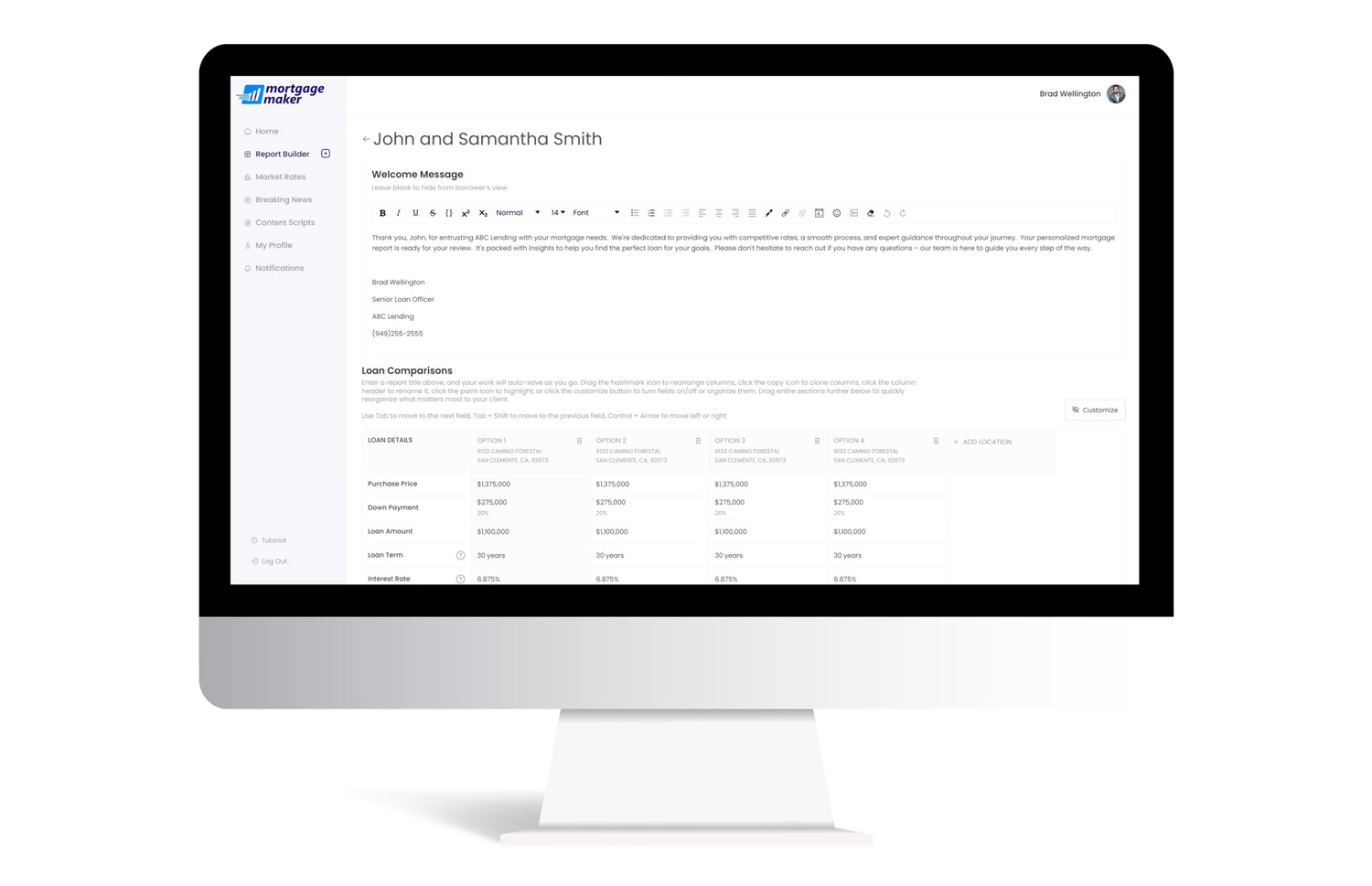
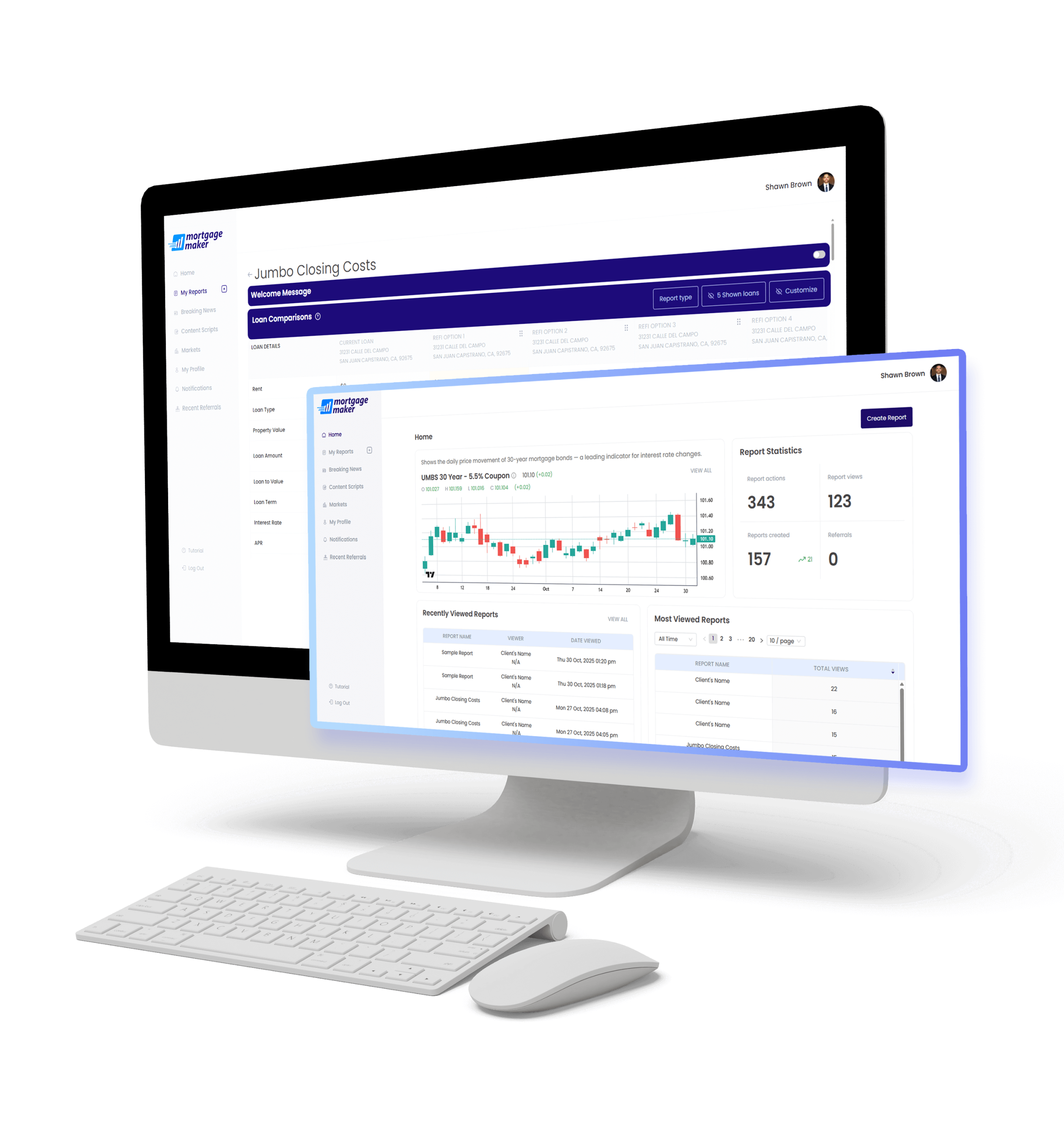
In Mortgage Maker, say the loan in a sentence: “500k purchase, compare a 30 fixed and a 5-year ARM.” The AI builds both columns side by side with taxes, an insurance estimate, closing costs and cash to close. Turn on the amortization schedule with one toggle so the month 60 balance is on the screen. Send her one link. You get a ping when she opens it and when she stars an option. For the three-option layout, see how to present loan options to borrowers. If she picks the ARM, when to lock is the next conversation.
FAQ
What is the simplest way to explain an ARM to a borrower?
Show one screen with four numbers beside a 30-year fixed: the starting payment, the months it holds, the worst payment at the first change and the payment at the life cap. On a $500,000 loan at the MBA’s October 2026 averages, that is $3,174 to start and $4,752 at the ceiling. Mortgage Maker builds both columns from one sentence.
What do ARM caps like 2/1/5 mean?
Caps of 2/1/5 mean the rate can rise up to 2 points at the first change and up to 1 point at each later change. It can never sit more than 5 points above the start rate. The real caps are in the Adjustable Interest Rate table on page 2 of the Loan Estimate.
How much does a 5-year ARM save compared with a 30-year fixed?
Using the MBA’s averages for the week ending October 9, 2026, 6.54% on a 5/1 ARM versus 7.50% fixed, a $500,000 loan saves about $323 a month in principal and interest. Over 60 months that is roughly $19,350, plus a balance about $4,800 lower. Mortgage Maker shows both side by side.
Who should not take an ARM?
A borrower who expects to keep the loan past the fixed period and cannot absorb the payment at the life cap should take the fixed. On a $500,000 five-year ARM starting at 6.54% with 2/1/5 caps, that ceiling is about $4,752 a month. Mortgage Maker puts both columns on one screen so the borrower can decide.
Rebuild your last ARM quote
Take the last ARM quote you sent and rebuild it as four numbers beside a fixed, worst case included. Start a 14-day free trial or book a live demo.